
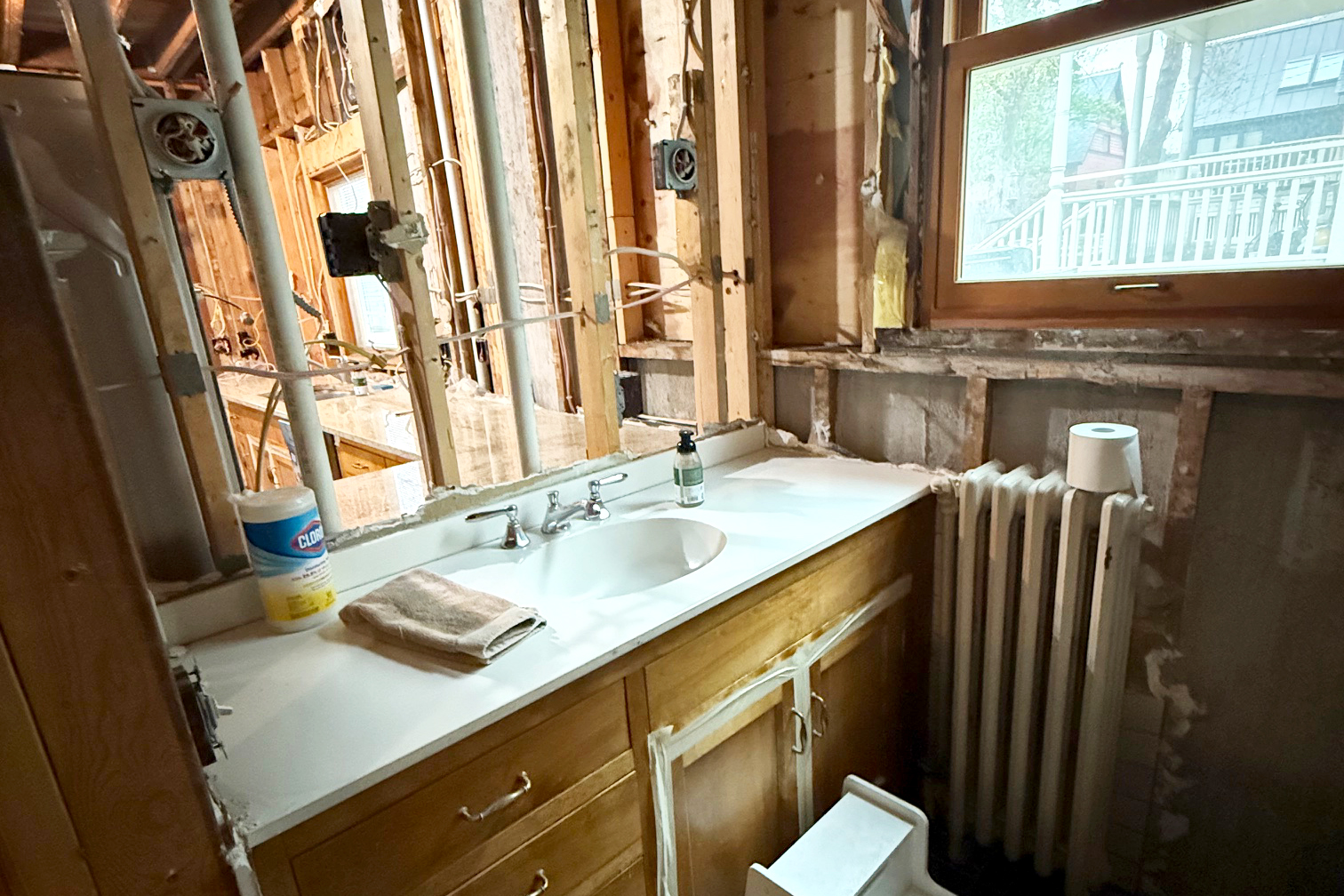
As a residential architect in Minnesota, I often tell clients that every renovation is an excavation as much as it is a design project. Opening up a wall in a century-old house is like unsealing a time capsule, sometimes you find craftsmanship of astonishing beauty, sometimes you uncover plumbing held together by little more than wishful thinking, and sometimes you discover both in the very same wall.
Renovating an older home is rarely simple, but it’s deeply rewarding. The process is part architectural problem-solving, part archaeology, and part storytelling. You learn the history of a place through its bones, and you make decisions that carry it forward for another generation of family life.
Opening Up Walls
The act of opening a wall is one of the most transformative moments in any renovation. For homeowners, it’s often the first time they truly see what their house is made of.
Minnesota’s housing stock is rich with bungalows, foursquares, Tudors, and farmhouses built between the late 1800s and mid-20th century. Many were constructed with plaster and lath walls, balloon framing, or early platform framing techniques. Unlike modern drywall, plaster carries a density and durability that surprises people—tearing it down is dusty, labor-intensive, and sometimes emotional.
But the payoff is real. Behind those surfaces, we often discover dimensional lumber that’s no longer available, true 2x4s hewn from old-growth forests, dense and straight-grained. Brick or stone chimney stacks tucked into unexpected places, sometimes long-abandoned but still proudly intact. Carpenter signatures or dates scrawled on studs—a builder’s quiet imprint left behind for future eyes. Open cavities that speak to a time before insulation was standard practice, when homes “breathed” in ways modern codes no longer allow.
Opening a wall gives us not only practical information—where to run new wiring, how to reconfigure a kitchen—but also a glimpse into history. It’s a reminder that our homes are not static structures. They’ve been evolving, patchworked, and adapted across decades.
Plumbing and wiring
One of the most immediate realities of renovating older homes is updating mechanical systems. Plumbing, in particular, tells stories.
In houses from the early 1900s, we often find galvanized steel pipes that have corroded nearly shut. By mid-century, copper became the standard, though it too may now show signs of pinhole leaks or poor repairs. And in homes touched by renovations from the 1980s or 1990s, we sometimes uncover polybutylene or early plastic piping, materials that were experimental at the time and have since proven problematic.
The same is true of electrical work. Knob-and-tube wiring—the standard until the 1940s—still exists in many Minnesota basements and attics. While it was ingenious in its day, with ceramic knobs isolating hot and neutral wires, it’s incompatible with today’s code requirements and modern electrical loads.
Updating these systems isn’t glamorous, but it’s essential. A home can’t serve its next century of life without plumbing and wiring that meets modern safety and efficiency standards. The challenge lies in weaving new systems into old bones without stripping away their character.
Flooring
Floors, perhaps more than any other element, bear witness to the lives lived in a home. When we peel back carpet or vinyl in a renovation, we often uncover hidden gems:
- Hardwood maple or oak floors, original to the home, scarred but ready to be refinished.
- Fir subfloors, once considered utilitarian, now admired for their rustic beauty.
- Patchwork repairs, where generations of homeowners replaced boards with whatever material was at hand.
There’s nothing quite like the moment a homeowner realizes that the floor they’ve been walking on—dull under linoleum or dated carpet—can be sanded and restored to a warm, glowing surface that ties them directly to the home’s history.
But not all surprises are good ones. We sometimes encounter asbestos tile, water-damaged joists, or evidence of long-gone mice who made a playground between floor layers. Each discovery shapes the design path forward, balancing preservation with practicality.
The Beauty of Structure
One of the unexpected joys of renovation is simply seeing the skeleton of a home. There’s elegance in the way beams are joined, the heft of a stone foundation, the rhythm of framing.
Historic builders often relied on materials that were both local and long-lasting. In Minnesota, that meant:
- White pine framing, abundant in the late 19th century.
- Limestone foundations, quarried close to home.
- Clay brick, manufactured in towns across the state.
When exposed, these materials remind us of the resourcefulness and craftsmanship of earlier generations. A hand-hewn timber in a 1920s farmhouse is not just structural, it’s an artifact of logging and milling practices that shaped the region’s economy.
As architects, we sometimes choose to highlight these elements in the finished design. Leaving a brick wall exposed or showcasing original beams brings authenticity to a renovation. It acknowledges that the home’s history isn’t something to be covered up—it’s something to be lived with.
Modern Codes vs. Historic Practices
One of the most complex aspects of working with older homes is reconciling historic building methods with modern codes.
For example:
- Insulation. Historic homes often had little to none. Today’s energy codes demand high-performance walls and roofs. But sealing a house too tightly can disrupt the natural ventilation patterns it once relied on, creating moisture problems if not carefully designed.
- Structural loads. Old-growth lumber can carry significant loads, but historic builders sometimes undersized beams compared to modern engineering standards. When we open up walls for an open-concept kitchen, we need to introduce steel or laminated beams that respect both code and aesthetics.
- Staircases. Older homes often feature steeper, narrower stairs than today’s codes allow. Preserving their character while meeting safety standards requires creative solutions.
The tension between past and present is constant. Codes exist to keep homes safe, durable, and efficient, but they don’t always account for the quirks of a 100-year-old house. My role is to bridge that gap—to honor the spirit of the home while ensuring it meets the expectations of modern living.
Hidden Gems and Happy Accidents
Not every renovation surprise is a challenge. Sometimes, we uncover details that become the highlight of a project.
A few memorable discoveries from my career:
- A set of lead-glass cabinet doors hidden behind a wall in a kitchen remodel.
- A newspaper from 1926, used as insulation, with headlines about local elections.
- A hand-carved newel post that had been boxed in during a mid-century update.
- A stone foundation wall so beautiful that the homeowners decided to feature it in their finished basement.
These moments remind us why we choose to work with older homes in the first place. Renovation isn’t about erasing the past—it’s about revealing it, celebrating it, and adapting it for modern life.
The Minnesota Context
Renovating in Minnesota carries its own set of conditions. Our climate demands durability. Freeze-thaw cycles test foundations, heavy snow loads challenge roof structures, and humidity creates opportunities for mold in poorly insulated walls.
Historic builders knew this. They built deep basements for storm protection, steeply pitched roofs to shed snow, and wide overhangs to protect siding. Yet no system is timeless. A limestone foundation may be stunning, but it needs repointing. A cedar shake roof may have lasted 70 years, but it eventually needs replacing with modern equivalents.
As an architect, I see my role as part preservationist, part innovator. I respect the strategies that kept these homes standing for a century, but I also bring tools and materials that can extend their lives into the next century.
Renovation as a Continuum
Every time we open a wall or lift a floorboard, we’re reminded that our work is part of a continuum. Someone built this home with care, someone else adapted it in the 1950s, and now we’re shaping it again for a new chapter.
I often encourage homeowners to think of renovation as stewardship. You’re not just updating a house for your own use, you’re contributing to its story. Future generations will someday open the walls we touch today. What will they see? Hopefully, they’ll see work that’s thoughtful, durable, and respectful of both history and modern standards.
Renovating old homes is rarely simple, but it’s always meaningful. Beneath the layers of plaster, flooring, and paint lies not just structure, but history. Each pipe replaced, each beam revealed, each floor refinished is part of honoring that history while ensuring the home’s future.
As a residential architect in Minnesota, I find joy in that balance. I get to stand at the intersection of past and present, translating the ingenuity of historic builders into homes that meet today’s needs.
And every time I open a wall, I’m reminded: the hidden gems aren’t just materials or artifacts. They’re the stories of people who built, lived, and loved within these walls long before we arrived. Our task is to listen, to learn, and to design with both respect and vision.